Metro Manila, over the decades, has slowly but surely grown to be one
of South East Asia’s bustling business hubs. The country’s unique
location and diverse workforce have allowed it to birth and nurture
both local companies and international corporations. So, it’s not
surprising that Manila is steadily evolving to accommodate the new
needs of a population composed of professionals, families, and even
retirees.
In the Heart of the Metro
Among the many
thriving cities in the metro, one of the most multifaceted locations
is in the boundaries of Pasig, Quezon City, and Mandaluyong. With
major tech companies, marketing startups, commercial districts filled
with restaurants and shopping centers, and a variety of both
recreational and business establishments, one of the most prevalent
developments have been sought-after
condominiums in Ortigas Center. This complements the
recent trend in which an increasing number of homeowners are opting
to invest in a condominium unit. Ortigas continues to be a popular
choice for these investors, whether they are buying or renting.
Aside from being
populated by a wide variety of businesses, Ortigas is also nestled
between Makati City and Quezon City, two other thriving districts. It
has the advantage of having a large array of options for transport,
with the metro railways and EDSA being a stone’s throw away. The
urban planning also ensures that most of the area is walkable with
wide sidewalks, accessibility, and clear signages, making it easy for
practically anyone to maneuver and find their way around.
Families and Opportunities
Considering that it
is close to prominent highways and large-scale establishments, the
city is still able to maintain a peaceful atmosphere, especially in
the residential areas where families with even young children opt to
live.
Although the busy
streets of Ortigas Center are perfectly fit for the lifestyle of the
working millennial market, the district has shown to be
family-friendly with its schools, medical facilities, and areas that
are either specifically geared towards families or simply open and
enjoyable for citizens of all ages.
This active growth
in community has led to staggering numbers, with demand
for residential space growing. Statistics have shown
that the development of new office spaces in the district will create
even more movement in the workforce and create more demand for
housing, with residential condos exceeding 50,000 units in presale
and more unit owners putting their properties up for rent.
Land dedicated to
office spaces has been shown to take upwards of 1.5 million square
meters. This demand is up to par with other avenues such as hotel and
leisure, showing that even tourists and visitors from other cities
are making numbers for the city. Locally, data shows that
“staycationers” take up a lot of demand for three and
four-star hotels. With traveling millennials taking up more than half
of the count for local travelers, budget hotels and hostels are also
sustained. Even luxury spots remain at capacity because of the influx
of travelers from consistent foreign markets such as South Korea,
Japan, and the United States.
With that, it seems clear that Ortigas Center has truly solidified its place as one of the modern powerhouses in the region. This not only benefits the local economy and the government, but simply gives people more options for whatever they want – a new place to work, a different scene they’d like to try, or a place to call home.
Contributed Post.
If you like what you’ve read here, please let others know of this post, blog, and site.
Mental health is currently an epidemic that is causing a generation of teens and adults a lot of trouble. Thankfully, the stigma surrounding it has eased recently, and now people are more willing to discuss their issues without the fear of their friends and family avoiding them.
However, coping with mental health is not done when you acknowledge you are struggling; it is only the beginning. It might be that you are currently undergoing treatment for depression, anxiety, or stress but are not seeing the results you hoped. It could be the treatment is not right for you, but there are other reasons your mental health is not improving.
You Aren’t Taking Advice On Board
You can attend all the therapy sessions you like and talk to professionals until you run out of things to talk about, but if you neglect to take on their advice for improving your mental health, then you will not see the improvements you hope for.
Taking this advice on board is crucial to helping you recover, even if it doesn’t work. Regardless of its success, you’ll be able to find a treatment that does work, which could allow you to feel better sooner.
You Are Holding Onto Existing Crutches
Part of recognizing mental health issues is discovering what crutches and habits are causing the problem. These issues could be a variety of things, including pornography addiction, smoking, or a harmful social media habit.
It’s difficult to remove these habits from your everyday routine, but if they are proven to have a negative impact, then distancing yourself from them is one of the first steps towards improvement. There might be times where you falter, but this is just part of the process, so keep on trying until it sticks.
You Aren’t Treating Your Body Well Enough
Whether it’s diet, exercise, or sleep, a healthy mind is made better by a healthy body. It’s understandable not to have the motivation to go to the gym, cook healthy meals, or get to sleep at a reasonable time when your mental health is affecting you, but you need to try.
To overcome this, try setting up routines that ease you into better habits instead of throwing yourself into unsustainable expectations. Start small and allow your routine to grow from there, and soon you will manage to take better care of your body.
You Aren’t Getting Out There
Isolating yourself from friends and family often seems like the best way to cope with issues, especially if you feel you don’t want to burden them with your problems. However, keeping yourself away from others who care about you means you are often trapped with your own thoughts, which can have adverse effects on how you feel.
Fixing to Change
You cannot expect to get better unless you dedicate yourself to making changes to your life that will benefit you. It is not enough to seek therapy or take medication; there needs to be a conscious effort from you to tackle your problems. Consider these reasons why your mental health isn’t improving, and see if making changes related to these has a positive effect on how you feel.
Contributed Post.
If you like what you’ve read here, please let others know of this post, blog, and site.
A few years ago, I went cellphone shopping with my seventy-year-old mom. Much to my surprise, she wasn’t shopping for a basic phone. No, she wanted an iPhone. I was shocked. I knew she could handle the upgraded technology, but I just assumed she wanted the path of least resistance and stay with what she knew. Leave it to my mom, once again, to prove that I don’t know it all.
Like many of my peers in their 40s and early 50s, I was too quick to put her and her generation into a box. I made unfounded assumptions, and lumped my mom into the stereotypical “older generation” of yesteryear, and I was astounded by her new fearless, “all in” approach to technology.
But then why should I be surprised? Fearlessness is what Mom’s generation was built on. Just think back to the 1950s. Their approach to so many different things—innovation, manufacturing, and social evolution—is their hallmark. And the 65.2 million boomers retiring look nothing like their predecessors, and their digital adoption is the greatest example of that.
And they’re not dabblers either. That’s right, boomers today not only use, but also engage in technology daily and even hourly.
What’s the Attraction?
It’s all rooted in Generation Z. It’s “grandchild factor.” Let’s be honest, it’s a big motivator – I mean, my mom barely acknowledges me when my daughter is around. But beyond those cute smiles and first-day-of-school pictures, the digital realm of possibility triggered their “take charge” attitudes as it did for my mom. Just like it did for Rebecca on the NBC’s mega hit “This is Us.” Her character joined Facebook to see pictures of her son’s newborn baby and it eventually opened up a new world of possibilities for her like connecting with old friends and even leading to a second marriage.
Keeping up with family and friends is the number one reason most all us go online, regardless of age. Think about it. While we all love our alone time, my introverted self especially, in the end we’re pack animals. We crave social connection. And today, with so many families and friends spread across the country, social platforms like Facebook and new technology such as smart phones have become our connectors. With that in mind, it only makes sense that all generations, especially boomers, would want to engage. For my mom, it was her innate yearning to be closer to me and my family who live over 2000 miles away. For me, it’s about staying close to friends whether down the street or across the country, and reconnecting with family, around the world, who I wouldn’t otherwise see.
So, it’s no wonder that technology adoption is exploding among all generations including boomers. It just makes us happier and when we’re happier, we’re healthier. Seriously. AARP reports that living alone over 50 is the equivalent of smoking 15 cigarettes a day on our health and studies have shown that loneliness can increase the likelihood of morality by as much as 30%.
Craving socialization also opens to a window as to why boomers and seniors are looking into alternative aging options like co-housing and house sharing. Not only are they the generation of invention, but they are also demanding more from their lives and retirement than their parents.
So, this holiday season, when your mom or dad asks for an iPad or a smart phone – don’t laugh. In fact, encourage it and encourage them to build their social connections both on and offline. Not only can it improve their happiness but their health, too. And it may even bring everyone in your family closer. And to that point, while technology is fantastic way to build social connections, nothing replaces genuine one-on-one contact – for them or for you. So, encourage their technology whimsy, but also take the opportunity to reconnect and inspire them to be more social overall.
Contributed Post.
If you like what you’ve read here, please let others know of this post, blog, and site.
As an adult, it can sometimes be difficult to resist the temptation to look at younger generations with a mix of envy and cynicism. One only has to spend a few moments on social media or watching rolling news to hear a story about how, supposedly, modern teenagers are the “snowflake” generation – while the list of industries that have supposedly been “killed” by millennials grows by the day. If an alien were to land on Earth tomorrow and get their information from the average cable news channel, they’d be forgiven for wondering what modern youngsters were up to, given the way they are portrayed in the media.
However, for those of us who have enough years under our belts to be able to look back on adolescence with some detachment, it’s wise to be a bit more forgiving. For one thing, every generation that has passed has, at one stage, been subject to the same cynicism from older generations. Everyone who has ever been a teenager has heard similar criticisms ringing in their ears and lamented that grown-ups “just don’t understand”. There is more than a grain of truth in that complaint. While adults may be envious of the opportunities and freedoms available to younger generations, we can never really understand the pressures that are placed on them.
If you doubt this for a moment, read on below to see why there are plenty of reasons why being a teenager or young adult in the present day is harder than it’s ever been.
1. Growing up in the digital age is scary
Anyone who grew up in the 20th century, or even the earlier years of the 21st, will have faced mostly the same pressures during their school days. Peer pressure, bullying and puberty all made adolescence a minefield – whether you were a teen in the 1950s or the 1990s. However, at no time have the stakes been quite as high as they are for someone who is at school in the present day. Thanks to the development of technology, we’ve moved quickly from being the internet age to the smartphone age.
While there is no denying that technology has offered us no end of opportunities, it has also brought with it an equally large number of headaches, and there is no doubt that it has brought a new dimension to bullying. Malicious rumours, unflattering photos and cruel videos are all much easier to share and can spread much more widely now than even a decade ago. Think back to how tough your school days were. Now imagine how much harder they would have been if everybody in your school had a multimedia editing suite in their pocket. If your teen is struggling with their mental health due to bullying, you can suggest they get help at programs such as Second Nature Utah.
There has long been an unspoken contract between generations that dictates that the younger one will inherit the world from its seniors in a better condition than when the latter received it. Through advances in the fields of medicine, technology and more besides, this has generally been the case, particularly financially. However, as we stand on the cusp of a new decade, it’s impossible for this generation to say that they will be able to keep the aforementioned contract.
The millennial and post-millennial generations are set to be the first in centuries to receive a world in worse shape than the generation before. Today’s young people are likely to be poorer than the previous cohorts. The average wage in the US has risen by 67% since 1970, which is great. Over the same period, however, the majority of basic living expenses have increased by more than that – in some cases multiplying many times over. That’s the world our young people are getting ready for.
Not only this, the young are inheriting a planet which is, by the agreement of a majority of scientists, entering a period of climate emergency. All of this, and they’re constantly being told that all of this is somehow their fault. It’s no wonder that the need for teen anxiety treatment is growing, when you look at it that way. It’s on older generations to better understand the pressures teenagers face.
3. More is expected of teens nowadays
Much is made of the increased opportunities on offer for today’s children, and with good reason. A teenager in 2019 will have access to information, initiatives and organisations that would have been beyond the wildest dreams of their parents or grandparents at the same age. There’s no doubt that this is something that goes in the “advantage” column for a modern teenager.
There is, of course, a “but” attached to this point, which is that with this greater level of opportunity comes more responsibility. By the time a modern teenager graduates from college, they are likely to be saddled with debt that could take them decades to pay back – and facing a cost of living that far exceeds what their grandparents experienced. In addition, to compete for the college places they want, teenagers may have to do unpaid voluntary work and add more extracurricular activities to stay ahead of the pack.
4. They’re expected to enjoy all of this
Amid the need to look out for cyberbullying, save more money and live a greener lifestyle, one thing that hasn’t changed about being a teenager is the general attitude of adults towards their younger counterparts. Now, this may sound like a criticism of adults, but it really isn’t. The way we look at the world changes as we get older, and it makes sense that when you are a gainfully-employed adult paying taxes in the “real” world, the concerns of teenagers will seem quite minor by comparison.
The thing is, it’s only through experience that we can make that comparison – so it’s a little unfair to expect teenagers to have that same perspective when they’ve had so much less time to get that experience. There are so many demands on them to grow up faster than we ever had to, and we’re expecting them to be grateful for a world that is more expensive, more intrusive and facing more pronounced changes than any other recent generation faced.
So if you find yourself any time soon looking at younger people with that mix of envy and cynicism, it’s worth remembering the above and giving them the leeway you wanted when you were their age.
Contributed Post.
If you like what you’ve read here, please let others know of this post, blog, and site.
As a passionate entrepreneur, you probably love to focus on innovative new ideas for your small business. Maybe those ideas work, too. Maybe you make sales and gain clients. However, taking the step from a small company to a large company can be a real challenge. That’s because it’s considerably more difficult to achieve long-term business success than it is to achieve short-term business success. It involves planning. It involves more than sales. Getting your business finances in order requires more than simply selling a lot of goods. It’s about the money that remains for the future. After all, your company needs funding to grow. That’s how it’ll expand into a large business over time. Fiscal responsibility is the key to success. In this article, you’ll find useful advice to help you get your small business’ money in shape and achieve long-term growth.
Research your target market constantly.
You should research your target market constantly if you want to create a successful business. Financially, this is incredibly important because research will help you to ascertain the best ways in which you should invest your profits. Rather than wasting money through a process of trial and error, talk to consumers in your target market. Talk to your existing customers and potential customers in your industry. Use social media to spark a direct conversation with people. That’s how you’ll start to find out what changes your target consumers want to see in your industry. As a result, you can make smart investments that will help you to fill gaps in the market and build a more successful company.
Outsource.
Outsourcing is another valuable way in which you could manage your business’ money more effectively. It’s a very fiscally-responsible way to increase your company’s daily output. Hiring new employees will help your business to grow, of course, but outsourcing is more cost-effective. You’ll still be getting help from professionals but on a temporary basis. Given that you and your small team of workers might only be skilled in certain areas, this could be very useful. You might want to do some research to see more information about this. An outsourced help desk could really help your business to grow in a cheap yet professional manner.
Use your time and money wisely.
Productivity isn’t just a buzzword used at training seminars. It’s one of the most essential ingredients for long-term business success. You need to use your time and money wisely if you want your company to run more efficiently and put more funding towards necessary investment opportunities in the future. In the first point, the importance of market research was discussed. This will help your small business to decide how best to invest your money. However, pinpointing great investment opportunities is only one side of managing your company’s finances more efficiently. You also need to reduce unnecessary costs. After all, if your overheads are too high, then you’ll be unnecessarily eroding your profit margins and giving your business less money to put towards worthwhile investments. Make sure your employees are as productive as possible. Automate services to speed up operations, for starters. And spruce up the workplace because pleasant surroundings can increase productivity, too.
Contributed Post.
If you like what you’ve read here, please let others know of this post, blog, and site.
As a business owner, it’s your job to work out what the next steps for your business will be. This means that you need to keep your eye on the ball, watch the competition and spot opportunities when they arise.
But what happens if you are new to the entrepreneurial lifestyle? How do you know the difference between a great opportunity and something too good to be true? What happens when you simply don’t know the answer?
Ask for Advice
When you don’t know what you’re doing, you should always ask for advice. Whether you turn to a friend or a fellow in business or you decide to approach other professionals for advice in a specialist area such as IT Consulting Services, asking the question is what counts.
Remember that when you ask for advice, you are starting a conversation. This isn’t just about you – you should also keep your ears open for ways you might help your advisor. The more people you talk to, the more you will learn but it’s also worth recognizing that this is a networking opportunity too. If the person you ask doesn’t know of a solution or can’t advise you further, they might be able to recommend someone who will.
Relax – Consider Your Options
One of the main reasons that entrepreneurs get stuck is that they allow anxiety to be a driver rather than creativity. When this happens, it can be difficult to see the wood for the trees and while opportunities could be everywhere, you stall because you don’t know how best to consider your options.
Relax.
A calm mind has much more room for creativity and as an entrepreneur, you need to be creative! A good way to do this is to write down your goals. Next, consider all the different ways you could achieve those goals or, even better, write down the stepping stones to get there. When it’s all laid out in front of you, it’s a lot easier to see which option is best and what to do next.
Run an Experiment
Experimentation is a major part of business and you should be experimenting all the time. Marketing is a great example of how businesses experiment but you should also be looking at different ways to push your business forward. If nothing else, experimenting allows you to explore new ideas without the same level of risk that adjusting the whole business would bring.
So, if you have a long list of options and you’re still not entirely sure which way to go, it might be worth splitting your cash and experimenting with two of your ideas. The key is to set up goals and clearly define what success means in each case. This way, you can see what might happen on a small scale and make a more informed decision about the direction you want to go in later on.
When you aren’t sure what to do, it’s usually because you haven’t got all the information clearly presented to you. Your job is research in any way possible and once you know better, you can decide with confidence.
Contributed Post.
If you like what you’ve read here, please let others know of this post, blog, and site.
Feeling frustrated in your career? If you wake up every morning feeling like you’re stuck in groundhog day and wondering ‘what’s the point?’ It’s time to make a change. When we spend so much of our time at work, if you’re highly dissatisfied and unhappy here, you’re never going to be fully happy in your life overall. Here are a few things you can do.
Try and move up
One of the reasons people start to feel trapped and dissatisfied within their job roles is that they become stagnant. They’re no longer learning new things, their earnings are limited and it all starts becoming very boring and samey. If the reason you dislike your job is because of this, have you considered moving up the ranks? If there’s scope for a promotion then take steps to try and achieve it, it might involve doing some additional education and training but could be so worth it. A higher position will often mean more money, and you’ll be doing things that challenge you again which can help you to feel more satisfied.
Change careers and start from the bottom
If you genuinely dislike the field you work in, then changing to something completely different could be the way to go. This is a bold move, often it will involve starting right from the bottom. This can feel disheartening if you’re moving from a job you previously had respect in due to your skills and experience, but it can be so worth doing. Decide what your end goal will be in your career and work your way up the ranks. The journey might change over time, but at least it gives you something to work towards and an idea of what you’ll need to do to get there.
Start your own companyOne reason many people can feel frustrated in regular career or job is they feel as though they’re working hard to build someone else’s dream for them. They can feel restricted by the confines of their career and feel their ideas would be better used elsewhere. If this sounds like you, why not start your own business? It can take hard work and dedication to get it off the ground, but once you’re set up you might feel far happier than you ever did working as an employee. You can be creative and think outside of the box, you can do things your way and earn money in a way that’s genuinely meaningful to you. Hire staff to help make your dreams a reality, utilise cloud solutions and all of the tech and software available to you to increase your chances of success.
Contributed Post.
If you like what you’ve read here, please let others know of this post, blog, and site.
“My flight was delayed 6 years ago. Back then, I had no idea that I could get compensated for that. Can I still get a compensation for that flight delay?”
This is what many passengers who have only recently been made aware of their air passenger rights wonder.
Well, yes, you can probably still claim your cancelled or delayed flight compensation – but there is a time limit. How far back you can claim varies from one country to the next.
If your flight was cancelled or delayed by at least 3 hours, you can get up to 600€ in compensation from the airline. Check if you’re eligible by filling out your flight information here – it takes only 3 minutes!CHECK YOUR FLIGHT NOW
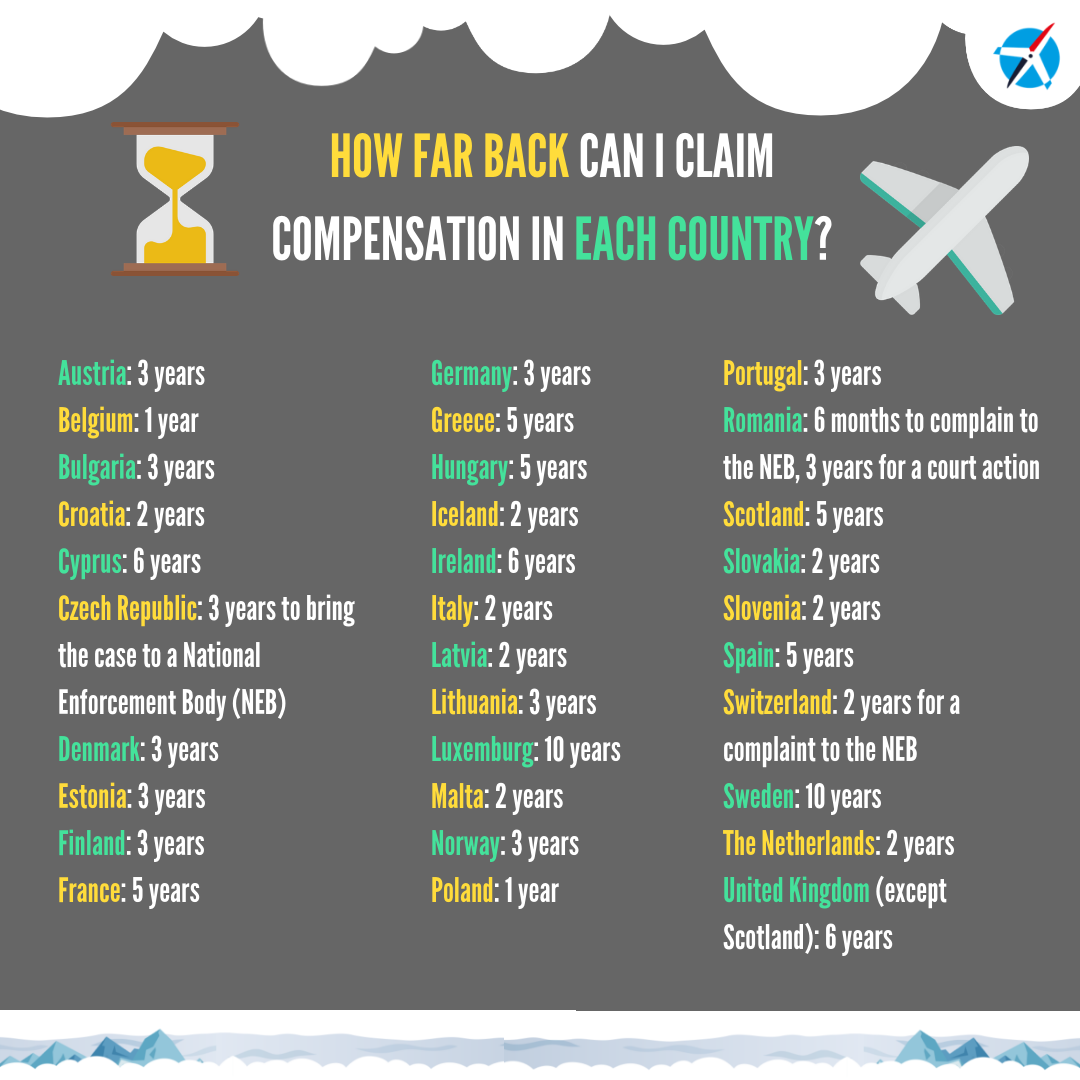
How Far Back Can I Claim Compensation In Each Country?
So you can claim for flight disruptions which happened years ago. But how many years exactly?
The time-limit depends on the legislation of the country you bring the claim to.
Here is an extensive list of countries in Europe, with how far back you can claim for each of them:
And here again in full text if that’s easier for you. This is how far back you can undertake court actions to claim compensation for your delayed or cancelled flight:
Italy: 2 years (Source: Italian Civil Code has rendered applicable in Italy the 2 years prescription of actions under Montreal 1999 also for claims arising from EC261)
Spain: 5 years (Source: Amendment of article 1964 of the Spanish Civil Code that reduces from 15 years to 5 years such period for the exercise of personal actions that did not have a special term. The calculation of the time limit, applies the fifth Transitional Provision of the Law 42/2015, in reference to article 1939 of the Spanish Civil Code.)
Switzerland: 2 years for a complaint to the NEB. You cannot undertake small court procedures (Source: Swiss Administrative Penal Act)
United Kingdom (England, Wales, Northern Ireland but NOT Scotland): 6 years
As you can see, there is no harmonization at the European level: each country has their own legislation on the matter.
For instance, in France, you can claim up to 5 years after the flight – but only 3 years in Germany and 3 in Italy. But you can still claim up to 6 years after the flight disruption in the United Kingdom.
However, keep in mind that to this day, no passengers on a flight disrupted over 6 years before got compensated. Even though it is possible, in theory.
How Do I Know Which Country To Bring My Claim To?
If you let ClaimCompass do all the work for you, then you don’t need to worry about that. Our legal experts will get in touch with the airline and the appropriate legal body.
Should you need to escalate your claim to a legal body such as a National Enforcement Body (NEB) or an Alternative Resolution Dispute (ADR) scheme, know that you can bring the case to the country of the departure airport or the arrival airport.
Whenever you have a choice, contact the legal body of the country where the legislation is most favorable to you: for example, in the case of a flight between the UK and Germany, contact the British NEB, since their statute of limitation is 6 years, versus 3 for Germany.
Can I Claim Compensation if My Flight Wasn’t in Europe?
When the EU Regulation 261/2004 isn’t applicable, can you still get money for your delayed, cancelled, or overbooked flight?
For international flights, the Montreal Convention acts as reference for your passenger rights – and it sets a time limit of 2 years to claim:
“The right to damages shall be extinguished if an action is not brought within a period of two years, reckoned from the date of arrival at the destination, or from the date on which the aircraft ought to have arrived, or from the date on which the carriage stopped” – Article 35, Montreal Convention
When the EC 261 isn’t applicable, you can still hope to be compensated under the Montreal Convention. Do not, however, that the time limit is shorter than in most European countries.
Plus, keep in mind that with the Montreal Convention, you are “only” eligible to compensation for damages incurred by the flight disruption. “Just” being delayed isn’t enough for you to get any money from the airline.
When you start a new business, you want to ensure that you do all that you can to ensure that you get the right exposure, engagement, and of course, the right levels of profit and success. But how can you make that happen? Here are some of the things to consider.
Your local community could hold the key to your business, and so it may be the time to focus on this area as an alternative method of marketing your business. There is a new trend where people are wanting to shop local and support their local small businesses, so you may wasn’t to join forces within your local community. This is your chance to become the expert in your industry and field locally. You could also sponsor local events as a great way to gain some exposure. This opens up different avenues of marketing such as face to face, as well as word of mouth as you become well known for what your business does.
Respond to comments and messages
It may feel like a lot of work, but people have taken the time to comment on your social media, send you messages or get in touch, so it is only right that you respond as quickly as possible. This can work really well through social media as engagement is just as important as sharing the content that you have decided to put out there. This can also humanise your business, and it can be a great way to make you appear reputable to potential new customers.
Try something new
Maybe you should try something new when it comes to your marketing programme. First of all, focusing on one social media platform could be the ticket, but what about the type of content you choose to share on there? These days social media platforms are more than just a status update or sharing a picture. Platforms now support video, live streaming as well as snippets on things like Facebook or Instagram stories. Where Instagram is concerned, you can buy Instagram likes which can enhance positive publicity for your business. This could be a great way to advance the type of content you share than just that standard words and pictures. People buy from people, so your new marketing ploy could be to provide a face to the business and to become relatable. After all, people do buy from people.
Make sure the cost and market is on point
It can be tricky to understand how you can make sure that your costings for the actual products you sell, or the type of services you offer, are on point to ensure that you can maximise the profits and the potential. This is when small business marketing automation software can really come in handy to help you make the right decisions for your small business.
Run a competition
A competition is an excellent way to build up an audience quickly, and so you may want to consider doing something like this if you are wanting to promote something. This could work well for a new product or service that you have that you want some extra exposure before launch. You could also provide incentive for followers if you manage to get to a certain level. However, ensure you check completion rules for different platforms so that you do things by the book.
Let’s hope that some of these options help you up your marketing game this month.
Contributed Post.
If you like what you’ve read here, please let others know of this post, blog, and site.
So you’ve just finished college, or maybe you’ve been out for a little while now and have no clue as to what you’re doing. Leaving college can be daunting because unless you want to go on to do further education, you’re now supposed to be facing the reality of adulthood. That’s terrifying because what if you don’t know what you want to do? You’ve lived as a student for a few years, and now you’ve been pushed out to fend for yourself. Here are some tips to help navigate life after college.
Your resume is the first port of call because you’ve probably either not looked it before going to college or you simply don’t have one. Some of us will have odd jobs throughout our school days, but many might not start their very first job until leaving school or college. So with that in mind, you want to work on the resume because this is what’s going to get you noticed and hopefully into those interview rooms for your dream job or career. If you’re refreshing an old resume, add on your education and then tweak the experience slightly to reflect what you’ve been doing in college. That might not be a lot, but every little helps. When writing your bio, keep it brief because you can always go into more detail if you need to provide a cover letter.
If you’re writing your very first resume, then you can find a simple template online. You want to make it stand out in a good way, so don’t go too fancy or complicated with the resume design. Keep it short and sweet, and ideally, you don’t want to go over two pages. If you haven’t had much experience, then it’s unlikely you’ll go over one page.
Speak To A Careers Advisor If You’re Lost
Trying to figure out what you want to do can be difficult, and there will be a point where you may feel so lost about what it is you actually want to do with the rest of your life. It’s a big ask after all. Careers advisors can be found down your local jobcentre, or you could go back to the college campus and speak to a student advisor there. They can offer you some professional advice and guide you through the options that you may have in front of you currently and what you might like to do in the future. Use this as an opportunity to discuss any worries or fears that you might have moving forward and ask questions. A careers advisor is going to certainly help you get some focus on what’s out there and what you should be doing next in order to secure a job, whether that’s something that starts off your career or whether you want to go straight for that dream job. It all depends on what skills and experience you need.
Get Your Finances In Order
Oh, the finances – let’s talk about that. When you go to college or university, the fees are going to be expensive, and so you may have a lot of student loan debt. It’s a good idea that you get a job as soon as possible as you want to start paying it back. However, it’s worth getting your finances in order and creating a budget for yourself so that you save your money to enjoy your adult life too. You can’t really afford to live that student lifestyle now. To get everything in one place, find out what you owe and who you owe it to. Try to consolidate all this into one loan if possible so you can keep an eye on it. You may want to refinance the loan if the current one isn’t really making much headway in paying it off. Keep on top of your budget and work with what you have from take-home and try to save any extra money you can in order to continue paying the loan off. It’s going to take a while, but it’s all worth it for the degree that you got in the process.
Expect To Fail At Some Point
This might be hard to hear, but everyone fails at some point. Some fail multiple times, and that’s ok because failure is a life lesson that is certainly worth learning. Don’t be worried about failing or going into a role that you might not be enjoying a few months later down the line. That’s completely normal, and it just means you have to figure out what it is you enjoy and what you’re not enjoying. Everyone’s different, and everyone finds their feet at different points.
It’s hard to come to terms with the reality that the role or job you wanted to go into might not be something you no longer want to do. However, that’s nothing to be afraid of, and you will certainly find the thing you want to do in life. It’s just going to take some adjustments and looking at what you are talented at.
Seek Advice For Job interview Prep
When you’ve found the job you’d like to go for, next comes the interview prep. If you’ve received notification of an interview, then congratulations! That was half the battle and now comes the decider on whether you’re right for the role or not. Always remember that even though you might have everything they need, you might not be the right suit for the company. That’s nothing against you as a person, it’s just who might fit the dynamic a little better. Interview preparation is a little daunting when you’ve not done it before. It’s always good to get some advice from friends and family or perhaps contacting someone in that current position on LinkedIn is a good idea. They might be able to give you some handy pointers on how they performed in the interview and what they feel may have swayed the judgement of the interview panel.
Before the interview, make sure you’ve practised the way you’ll speak to people before and during the interview. It might be good to have someone do a mock interview so that you can practice some questions that might be similar to the ones asked in the interview. Think about the clothing you wear in relation to the type of company it is and always approach the interview with confidence and a smile. Don’t be boastful or try to fake your way through an interview because chances are, they’ll see right through it. Just be yourself and be honest if you don’t know how to answer a question. Ask questions back, too, when given the opportunity to do so.
Experience Is Needed
Even though you’ve just spent an ample part of your life studying, to be told that experience is valued moreover a degree is a bit of a gut punch but its true. A lot more employers will want experience over qualifications. That doesn’t mean that qualifications are useless. If you had the experience and qualifications, and someone just had experience, then who do you think is likely to get it? Don’t get too down-hearted if you lack the experience because you might impress them enough with your personality and how you come across to them, in person. There will be times where you need to start from another role and build yourself up with experience before you can go for that dream role. Everyone has to start somewhere, so don’t feel like you’re missing out or starting too late in your career.
Know Who Your Friends Are
You make friends throughout your lifetime and those that you had in college, might not be your lifelong friends. The same goes for those you make in school, those in your hometown and those at work. You are likely to have a mixture and perhaps a small selection of constant friends who drift in and out of your life. Only you know who your true friends are because they are the ones you call on first to meet up for drinks. They are those people who you call in an emergency because the chances are, they’ll be there ready to do whatever you need them to do. Friends come, and friends go, and even though it might be tough to grasp, that’s adult life. We all have our careers and our personal lives to live, and that might mean that you miss seeing others for a while. However, those friends who are going to stay will make an effort to see you and vice versa.
Navigating life after college is tough, but like everything in life, you learn to adapt to the change, and you’ll find your rhythm eventually. So work on your resume if it’s a little bit out of date and speak to a careers adviser if you’re having trouble picking your career path. Sort you your finances moving forward, work on your experience and get ready for your life as an adult. It’s going to be a bumpy ride!
Contributed Post.
If you like what you’ve read here, please let others know of this post, blog, and site.